

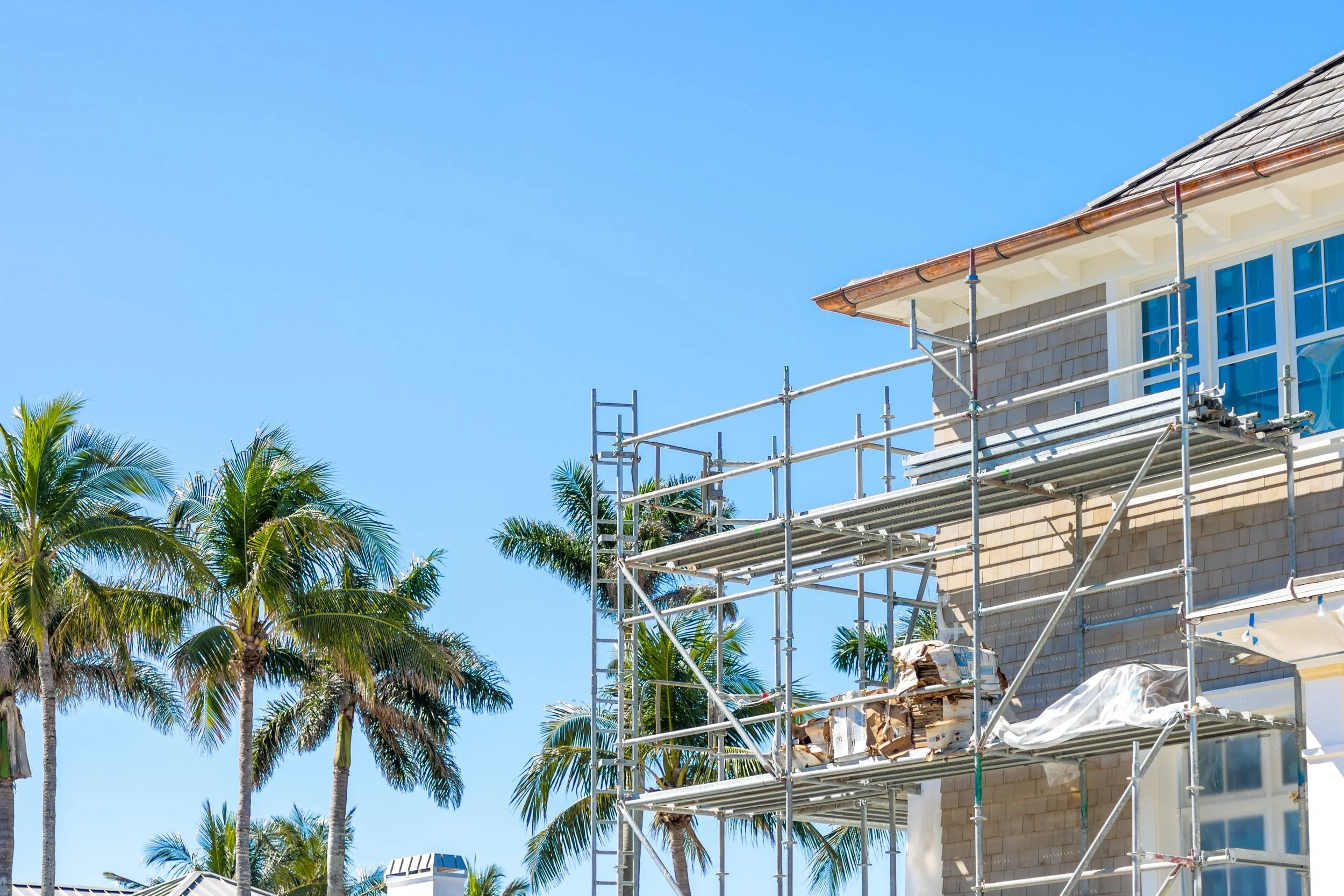
Independent agency · Stuart, FL
Builder's Risk Insurance in Florida
Builder's risk, also called course of construction insurance, is designed to insure a building and its materials while work is underway. Our Stuart office helps homeowners, builders and contractors review their options before construction begins.

- Independent agency since 2017
- 40+ carrier appointments
- Local office in Stuart
Insurance for homes and buildings under construction
Building a new home, taking on a major renovation or managing a construction project? This guide explains what builder's risk can cover, what it usually does not, how long it lasts and what to have ready when you request a quote, with a focus on homes and projects across the Treasure Coast and Florida.
What is builder's risk insurance?
Builder's risk insurance is a type of property insurance for a building while it is under construction or going through a substantial renovation. Depending on the policy, it can cover the structure, the building materials and certain temporary property on the job site if they are damaged or destroyed by a covered cause of loss, such as fire, windstorm, theft or vandalism.
You will also hear it called course of construction insurance, because coverage follows the project through the course of construction. As walls, roofing, windows and finishes are added, the value at risk grows, and the policy is designed around that changing value.
A standard homeowners policy is written for a finished home that someone lives in. It is generally not built for a structure that is still going up, an empty lot full of materials, or a home that is gutted and unoccupied during a remodel. That is why builder's risk is usually arranged before work begins, so coverage can be in place before the first delivery of materials.
Who buys the policy depends on the project. It may be the property owner, the builder or general contractor, or another party with an insurable interest, meaning a financial stake in the property, such as a construction lender. The right policyholder and the parties included on the policy depend on ownership, the construction contract and the project's circumstances.
Who needs builder's risk insurance?
Builder's risk is not only for large commercial projects. Here is how it can apply to the people we hear from most.
Homeowners building a new home
If you are building a custom home, the structure and the materials on site represent a significant investment long before you move in. Builder's risk is commonly used to insure that investment during construction. Your contract should make clear whether you or your builder is responsible for arranging coverage.
Homeowners completing major renovations
Major kitchen renovations, full home remodels, structural or room additions, and extensive roof or building reconstruction can create exposures a standard homeowners policy may not fully address, especially if the home is unoccupied during the work. Small repairs and cosmetic updates usually do not call for a separate builder's risk policy.
General contractors and builders
Builders often arrange builder's risk for residential and commercial projects they build. Accurate project values, scheduled job locations, realistic construction timelines and a clear list of every party with an insurable interest all affect how the policy is written.
Property developers and investors
Developers and investors building or substantially renovating properties, including spec homes and investment properties, may need builder's risk to meet lender requirements and to insure the project until it is sold, leased or placed on a permanent policy.
Commercial construction projects
Builder's risk can also apply to eligible commercial construction, such as offices, retail buildings and other commercial structures. Availability and underwriting requirements vary widely by insurer, construction type, project size and location. Condominium associations planning major projects may also want to review how builder's risk fits with their condo association master policy.
Planning a build or renovation? Talk with a local agent before work begins.
What kind of project are you planning?
Choose the project that sounds most like yours to see the builder's risk topics worth discussing with an agent.
New home construction: Building a new home from the ground up
For a new custom home, builder's risk is the type of policy commonly used to insure the structure and materials until the home is finished and permanent coverage begins.
Topics to discuss with an agent
- Whether you or your builder is responsible for buying the policy under your contract
- The completed value of the home, not counting the land
- Windstorm, named storm and flood provisions for your specific address
- Theft of materials before they are installed
- How and when the policy ends, and when to start your homeowners quote
Major home renovation: Remodeling a home you already own
Large remodels can create exposures a standard homeowners policy was not written for, especially if the home is vacant during work or the structure is opened up.
Topics to discuss with an agent
- Whether the existing home stays on your homeowners policy during the work
- Whether the home will be occupied, unoccupied or vacant while work is done
- The value of the renovation versus the value of the existing structure
- What your homeowners insurer needs to know about the project
- Theft and weather exposure while walls or the roof are open
Home addition: Adding square footage to an existing home
An addition ties new construction to an existing structure, so it is important to know which policy responds to which part of the home.
Topics to discuss with an agent
- How the new addition and the existing home are each insured during construction
- The value of the addition and any change orders
- Whether materials will be stored on-site or off-site
- Updating your homeowners coverage once the addition is complete
Commercial construction: A new commercial building
Commercial projects often involve lenders, multiple contractors and contract insurance requirements, and underwriting varies widely by insurer and project.
Topics to discuss with an agent
- Contract and lender requirements for builder's risk
- Everyone with an insurable interest who should be included
- Completed value, soft costs and delay-in-completion options
- Construction type, project length and site security
- Windstorm and flood treatment for the location
Commercial renovation: Renovating an existing commercial property
Renovating an existing building raises the question of how the existing structure and the new work are insured, and whether the building stays in use during construction.
Topics to discuss with an agent
- Whether the existing building remains on its property policy
- Whether tenants or operations continue during the work
- Ordinance or law exposures if the work triggers code upgrades
- Renovation value, timeline and site security
Builder or contractor project: Coverage arranged by a builder or GC
Builders and general contractors often arrange builder's risk for the projects they build, either one project at a time or on a reporting basis for multiple projects.
Topics to discuss with an agent
- Single-project policy versus a reporting form for several jobs
- Scheduled project locations, values and start dates
- Including the owner, lender and subcontractors as needed
- Your separate general liability, workers' compensation, equipment and commercial auto coverage
Other: Something else
Not every project fits neatly into a category. Repairs after a loss, partially completed projects and unusual structures may each need a different approach.
Topics to discuss with an agent
- What is being built or repaired, and who owns it
- How far along the work is today
- The value of the work and the expected completion date
- Any contract or lender insurance requirements
This guide is for general education only. It does not determine eligibility, guarantee coverage or replace a review of your project and the policy itself.
What does builder's risk insurance cover?
Builder's risk policies are not standardized, so what is included varies by insurer, policy form and endorsements. These are the types of property a policy may cover, from the core of most policies to items that often need specific wording.
The building under construction
The structure itself as it is built, from foundation and framing to the finished building, against covered causes of loss during the policy period.
Construction materials and supplies
Materials intended to become part of the finished project, such as lumber, roofing materials, windows and doors, cabinets, flooring, plumbing and electrical materials, and fixtures, while they are at the job site.
Temporary structures
Some policies cover eligible temporary property used for the project, such as temporary buildings, storage structures, construction trailers, scaffolding, fencing and construction signs. Limits for these items are often lower than for the building.
Equipment and machinery
Certain equipment and construction-related property may be eligible depending on the policy. Contractor-owned tools, heavy equipment and machinery are generally insured separately and are not automatically covered by builder's risk.
Materials in transit or temporary storage
Some policies extend coverage to eligible materials while they are being transported to the site or stored temporarily at another location, often with a separate limit. Confirm this in the actual policy.
Landscaping and outdoor property
Trees, shrubs, lawns, fences and other outdoor property may be eligible only through specific policy provisions or endorsements, frequently with limits. They should not be assumed to be included.
Debris removal
After a covered loss, some policies help pay to remove debris from the damaged property so work can resume, subject to the policy's limits and conditions.
Additional coverage options to ask about
The following are not included in every builder's risk policy. They may require special provisions, endorsements or separate coverage, and availability depends on the insurer and the project.
- Soft costs
- Certain added expenses after a covered loss, such as extra interest on a construction loan, additional permit or design fees, or other project costs beyond physical repairs.
- Delay in completion
- Some lost income or rental value when a covered loss pushes back the date a building can be occupied or used. More common on commercial and income-producing projects.
- Additional expenses after a loss
- Extra costs to speed up or resume work after covered damage, where the policy provides them.
- Ordinance or law
- Additional costs to rebuild to current building codes after a covered loss, which can matter for renovations of older structures.
- Testing and equipment breakdown
- Coverage related to testing new building systems such as HVAC or electrical. Often limited or excluded unless specifically added.
- Existing structures under renovation
- Whether the existing building is covered by the builder's risk policy or stays on its current property policy during the work.
- Off-site materials and temporary storage
- Higher limits or broader terms for materials kept at a supplier, warehouse or storage yard before installation.
What does builder's risk insurance not cover?
This is where many construction insurance surprises happen. The lists below describe common limitations, not a universal set of exclusions. Actual coverage depends on the carrier, policy form, endorsements and the circumstances of a loss.
Usually handled by other policies
- Injuries to visitors or passersby and damage to other people's property, which are general liability exposures
- Injuries to workers, which are generally a workers' compensation matter
- Vehicle accidents involving trucks and vans used for the job, which fall under commercial auto insurance
- Contractor tools and equipment not included in the policy, usually insured under the contractor's own equipment coverage
- Property that is not part of the insured project, such as a neighbor's home or unrelated buildings
Common exclusions and limitations
- Flood and surface water, often excluded or limited
- Earth movement, such as settling, sinkholes or earthquake, depending on the policy
- Wear and tear, deterioration, rust and similar gradual damage
- Faulty workmanship, defective materials and design errors, though some policies cover resulting damage
- Mechanical or electrical breakdown, unless specifically added
- Theft of certain property, such as uninstalled materials, where restricted or excluded
- Losses outside the policy period, before coverage starts or after it ends
Review flood, windstorm and theft specifically. These three exposures vary the most between builder's risk policies, and in Florida they matter most. Some policies include them with separate deductibles or limits, some exclude them, and some offer them by endorsement. Builder's risk also does not replace a contractor's general liability or workers' compensation insurance. For contractors and other businesses, those coverages are part of a broader business insurance program.
Builder's risk vs. general liability vs. homeowners insurance
A construction project often involves several policies working together. None of them replaces the others.
| Policy | Generally designed for | Example situation | Typically purchased by |
|---|---|---|---|
| Builder's risk | Eligible property during construction or a qualifying renovation | A windstorm damages the partially framed home and materials on site | Owner, builder or general contractor, per the contract |
| General liability | Certain third-party bodily injury and property damage claims arising from business operations | A visitor is injured on the job site, or work damages a neighbor's property | Contractors and other businesses |
| Workers' compensation | Medical care and lost wages for employees injured on the job | A crew member is hurt while working on the project | Employers, including contractors and subcontractors |
| Commercial auto | Vehicles used for business | A contractor's work truck is in an accident on the way to the site | Businesses that own or use vehicles for work |
| Homeowners | An eligible completed residence, certain personal property and personal liability, subject to the policy | A storm damages the finished, occupied home | The homeowner, once the home is complete |
Planning the handoff. When construction ends, coverage needs to move from the builder's risk policy to a permanent policy without a gap. For a finished residence that usually means homeowners insurance, or high value home insurance for larger custom homes. Start that conversation well before your expected completion date.
Understanding project values and coverage limits
The amount of builder's risk insurance matters. If the limit is too low, a serious loss late in the project may not be fully covered. Builder's risk limits are generally based on the value of the construction project. Your construction contract and your builder's budget are usually the starting point, and the values and limits you request are your decision; Manchester Insurance does not estimate, appraise or set project values.
Items that are commonly part of the project value include:
- Estimated construction cost
- Completed value of the structure
- Materials and labor
- Contractor overhead and expenses
- Fixtures and finishes
- Change orders and upgrades
- Existing structures, where applicable
- Other eligible project costs
- Not included: the value of the land
Change orders and upgrades can raise the cost of a project after the policy is bound. Let your agent know when the project value changes so the limit can be reviewed.
How long does builder's risk insurance last?
Builder's risk is written for a set policy term meant to match the expected construction schedule. It does not run indefinitely, and it is not designed for a finished, occupied building.
Termination provisions vary by policy. Coverage commonly ends at the expiration date or at an earlier event named in the policy, such as completion, occupancy, sale or acceptance of the work. The five stages here show where timing usually matters.
Prefer to talk? Call (772) 530-5305
-
Before construction begins
Arrange builder's risk before ground is broken or the first materials are delivered. A policy generally does not respond to losses that happen before its start date, and insurers may decline or ask more questions about a project that is already underway.
Confirm who is responsible for buying the policy under your construction contract and what your lender needs to see before work starts.
-
Construction in progress
As the building goes up, the value at risk grows. Builder's risk is designed to cover eligible property during this period, subject to the policy's covered causes of loss, limits, deductibles, conditions and exclusions.
Let your agent know about change orders, upgrades or changes in scope that affect the project value, so the limit can be reviewed.
-
Construction delays
Weather, permitting, inspections and material availability can push a project past the policy's expiration date. If that looks likely, ask about an extension or renewal before the policy expires.
Extensions are up to the insurer and may carry additional premium. An unfinished building left without coverage may be uninsured.
-
Project completion
Many builder's risk policies end at completion, occupancy or another event named in the policy, which can come before the expiration date. Under some policies, moving furniture in, living in part of the home or putting a building to use can trigger these provisions.
Read the policy's completion, occupancy and termination wording rather than relying on the expiration date alone.
-
Transition to permanent coverage
Arrange permanent property insurance, such as homeowners insurance for a finished home or a commercial property policy for a business building, so it begins before builder's risk ends.
Start that quote a few weeks before your expected completion date to leave time for underwriting.
The goal: no gap between the construction policy and the permanent policy.
Builder's risk in Florida and on the Treasure Coast
Construction in Florida comes with exposures that deserve a careful look at the policy. Whether the project is a custom home in Palm City, a riverfront renovation in Stuart, a new build in Port St. Lucie or a coastal project on Hutchinson Island, the same questions come up.
Hurricane and windstorm
Atlantic hurricane season runs from June 1 through November 30, and many projects are under construction during at least part of it. Some builder's risk policies include windstorm with a separate deductible, and some exclude it. Many insurers also stop issuing new coverage when a storm threatens, so plan ahead.
Flood and heavy rain
All of Florida is in a flood zone; the only difference is a high flood zone or a low one. Flood and surface water are often excluded or limited in builder's risk policies, so ask how the policy treats flood and whether separate flood insurance is needed. Heavy rain on an open structure is a separate question worth asking about.
Coastal construction
Distance from the ocean, the Indian River Lagoon or the St. Lucie River, along with construction type and project value, can affect whether an insurer will write the project and at what price. Insurers do not all accept the same risks.
Theft and site security
Building materials stored outdoors and unoccupied job sites can attract theft and vandalism. Fencing, lighting, locked storage and scheduled deliveries can help, and some policies have security conditions or theft limits.
Construction delays
Weather, permitting, inspections and material availability can stretch a schedule. Build realistic timing into the policy term and know how extensions work.
Unoccupied buildings
Homes under renovation are often empty for weeks or months. Vacancy can affect both builder's risk and an existing homeowners policy, so tell your agent how the property will be used during the work.
We serve property owners and builders in Martin, St. Lucie and Indian River counties, including Stuart, Port St. Lucie, Palm City, Jensen Beach, Hobe Sound and Vero Beach, as well as northern Palm Beach County, including Jupiter, Tequesta and Palm Beach Gardens. Availability for any project, in any location, depends on the insurer.
What affects the cost of builder's risk insurance?
There is no single standard rate for builder's risk. Each insurer evaluates the project on its own details, which is why accurate information up front leads to more useful options.
A new custom home, a major renovation and a commercial building can be priced very differently. A renovation involves an existing structure and how it is used during the work. A new home starts at zero value and grows to the completed value. A commercial project may involve larger values, longer timelines and optional coverages such as soft costs or delay in completion.
We do not publish average premiums, because a number that is not based on your project would not be useful to you. For more on how Florida home insurance pricing works once the home is finished, see what affects home insurance prices in Florida.
Common rating factors
- Total project value
- Type of construction
- Construction materials
- Project location
- Coastal exposure
- Expected duration
- New build or renovation
- Percentage complete
- Contractor experience
- Site security
- Coverage limits
- Deductibles
- Optional coverage
- Prior losses
Information needed for a builder's risk quote
You do not need everything on this list to start a conversation, and what the insurer asks for varies by project. Having these details on hand helps the quote process go more smoothly. Check off what you have ready. Nothing you check here is saved or sent anywhere.
Have the basics? Request a builder's risk quote online or call our Stuart office.
A local independent agency for your construction project
Manchester Insurance is an independent property and casualty insurance agency based in Stuart, Florida, founded in 2017 and serving the Treasure Coast. We hold appointments with more than 40 insurance carriers across personal lines, commercial lines and specialty programs. Not every carrier we are appointed with writes builder's risk, and those that do have different guidelines for project types, values and coastal locations. Whether coverage is offered for a particular project is up to the insurer.
Local service
A Stuart-based team that works with Treasure Coast property owners, builders and businesses.
Florida experience
Familiarity with the wind, flood and coastal questions that come with building in Florida.
Organized project details
Help identifying the project information insurers typically ask for before they review a project.
Market evaluation
As an independent agency, we are not limited to a single company's product and can look at the markets that may consider your type of project.
Clear explanations
Plain-English help understanding coverage options, exclusions, deductibles and how the policy ends.
Homes and businesses
Coverage help for homeowners, builders and commercial clients, from the construction phase to the permanent policy.
Ready to talk about your project?
Whether you are breaking ground on a new home, starting a major renovation or managing a commercial build, the best time to review builder's risk is before work begins. Request a quote online or speak with a local insurance agent.
Builder's risk insurance FAQs
Short answers to common questions from homeowners, builders and property owners. These are general explanations; your policy's wording controls what is covered.
What is builder's risk insurance?
Builder's risk is property insurance for a building while it is being built or substantially renovated. Depending on the policy, it can cover the structure, building materials and certain temporary property on the job site against covered causes of loss such as fire, windstorm or theft. It is also called course of construction insurance.
Is builder's risk insurance required in Florida?
Requirements usually come from the project paperwork. Construction lenders commonly require builder's risk as a loan condition, and construction contracts often state whether the owner or the contractor must buy it. Review your loan documents and contract, ask your lender what it needs to see before work begins, and have your attorney review any contract terms you have questions about.
Who should buy builder's risk, the homeowner or the contractor?
Either one can, depending on the contract. Some builders include builder's risk in their price, while other contracts make the owner responsible. What matters is that one policy is clearly assigned, that it includes the parties with an insurable interest, such as the owner, the builder and the lender, and that nobody assumes the other side has it. Your attorney can review the insurance requirements in your construction contract.
Does builder's risk cover a home during construction?
It is designed for that purpose. A builder's risk policy can cover the home as it goes up, with the value at risk growing as work progresses, subject to the policy's covered causes of loss, limits, deductibles and exclusions.
Does builder's risk cover major renovations?
Some insurers offer builder's risk for remodels and additions to existing homes. The existing structure may be included or may need to stay on another policy. Eligibility depends on the scope of work, the renovation value and whether the home is occupied. Small repairs and cosmetic updates usually do not call for a separate policy.
Does builder's risk cover construction materials?
Materials intended to become part of the finished building, such as lumber, roofing, windows and cabinets, are generally at the center of builder's risk coverage while they are at the job site. Coverage for materials before delivery or away from the site depends on the policy.
Are materials stored off-site covered?
Sometimes. Some policies include limited coverage for materials in transit or at a temporary storage location, often with a separate, lower limit. If your builder stores materials away from the site, confirm those limits in the policy itself.
Does builder's risk cover theft?
Some policies cover theft of covered property, but theft is a common place for conditions and restrictions. Some policies limit theft of materials that are not yet installed or require site security such as fencing or locked storage. Review the theft wording before construction starts.
Does builder's risk cover hurricane damage?
Some policies include windstorm and hurricane coverage, often with a separate deductible, and some exclude wind entirely. On the Treasure Coast this is one of the most important provisions to confirm, and coverage is best arranged well before a storm is approaching.
Does builder's risk cover flood damage?
Do not assume it does. Flood is often excluded or limited in builder's risk policies and may need separate flood coverage. All of Florida is in a flood zone; the difference is whether the site is in a high flood zone or a low one.
Does builder's risk cover contractor tools?
Usually not. Contractors' tools and equipment are generally insured under the contractor's own equipment or inland marine coverage. Some builder's risk policies offer limited coverage for certain equipment or temporary items, so check the policy wording.
Does builder's risk include general liability?
Generally, no. Builder's risk is property coverage. Injuries to visitors and damage to a neighbor's property are general liability exposures, and injuries to workers are generally a workers' compensation matter. Those need their own policies.
How much builder's risk insurance do I need?
The limit is generally based on the completed value of the construction project, not the land. Your construction contract and your builder's budget are usually the starting point, and the limit should be revisited if change orders or upgrades raise the cost.
How is builder's risk insurance priced?
Insurers look at the project value, construction type, location and distance to the coast, project length, new construction versus renovation, site security, deductibles and any optional coverage. There is no single standard rate, which is why accurate project details matter.
How long does builder's risk insurance last?
Policies are written for a set term meant to match the expected construction schedule. Coverage typically ends at the expiration date or at an earlier event named in the policy, such as completion or occupancy, whichever the policy says comes first.
What happens if construction takes longer than expected?
Contact your agent before the expiration date. Some policies can be extended, but extensions are up to the insurer and may carry additional premium. Letting a builder's risk policy lapse on an unfinished building can leave it uninsured.
When should I switch to homeowners insurance?
Plan the switch before the builder's risk policy ends, which is often tied to completion or occupancy. The goal is for the homeowners policy to start with no gap, so begin the homeowners quote a few weeks before your expected completion date.
This page provides general information about builder's risk insurance and is not an offer of coverage, a binding quote or a guarantee that coverage is available. Coverage, eligibility, limits, deductibles and pricing are determined by the insurer and the terms of the policy issued. Read your policy for complete details. Manchester Insurance does not provide legal advice; construction contract and loan requirements should be reviewed with your attorney or lender.