

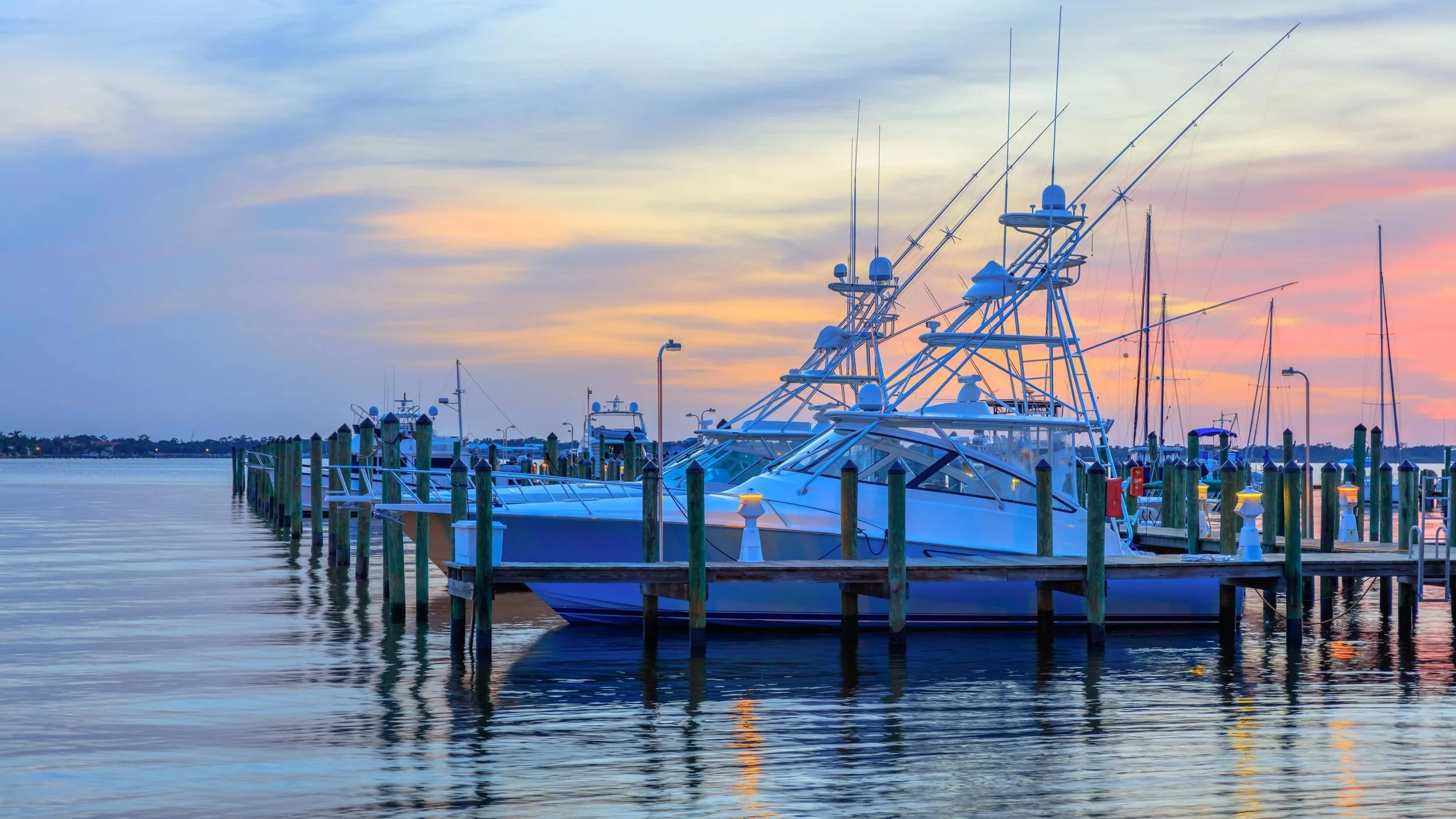
Boat Insurance in Stuart, FL
From the St. Lucie River to offshore runs out the inlet, we help Stuart and Treasure Coast boat owners find out which insurance companies will consider their boat and how the coverage really compares.
- Independent agency since 2017
- 40+ carrier appointments
- Serving the Treasure Coast from Stuart
Boat insurance for the way people boat around Stuart
Some boats here never leave the St. Lucie River. Others run out the St. Lucie Inlet before sunrise and spend the day chasing sailfish offshore. Some sit on a lift behind the house, some live at a marina, and some ride home on a trailer after every trip. Each of those boats can need a different kind of policy.
Boat insurance helps pay for damage to your boat and for harm you may cause to other people or their property while boating. What you can get, and what it costs, depends on the boat and on you. Insurance companies look at the boat's age, value, size and engines, where it is kept, how far from shore you go, who drives it, and your claims history. Each company has its own rules, and not every company writes every boat.
That is why it helps to talk to someone who works with boat owners on the Treasure Coast. Manchester Insurance is an independent agency based in Stuart. We can look at the options available for your boat and walk you through how they differ before you choose.
The short version
- Boat insurance usually has two main parts: coverage for the boat itself and liability coverage for injuries or damage you cause.
- Hurricane and named-storm rules, deductibles and navigation limits can differ a lot from one policy to the next.
- Your price and eligibility depend on the boat, how and where you use it, where you keep it, and the insurer's underwriting.
- As an independent agency, we can review options from more than one insurance company, when they are available for your boat.
What does boat insurance cover?
Here are the coverages you will see most often on a boat policy. Some are included on many policies. Others are optional, limited, or not offered by every insurer. Your actual policy, not this list, decides what is covered.
Physical damage (hull)
Pays to repair or replace the boat itself after a covered loss, such as a collision, fire, theft, or storm damage. This is the part often called hull coverage.
Engines and attached equipment
Covers motors and equipment that are built in or bolted on, like electronics, T-tops and trolling motors, when damaged by a covered cause. Wear and tear and many mechanical breakdowns are usually not covered.
Personal property and gear
Helps with gear you bring aboard, like rods, reels, tackle, coolers and life jackets. Limits are often lower than people expect, so ask about expensive fishing equipment.
Liability
Helps if you are found responsible for hurting someone or damaging their property with your boat, like hitting a dock or another vessel. It can also help pay for your legal defense. For higher limits, many boat owners add a personal umbrella policy.
Medical payments
Helps pay medical bills for you or your passengers after a boating accident, usually up to a small set limit, often regardless of who was at fault.
Uninsured boater
Where offered, helps if you or your passengers are hurt by a boater who has no insurance or not enough. Many boats on the water carry no coverage at all.
Fuel spill and pollution
Where offered, helps with cleanup costs and liability if your boat leaks fuel or oil into the water after a covered accident.
Wreck removal
If a boat sinks or washes ashore, the owner may be responsible for removing it. Some policies include this, some include it inside the hull limit, and some add a separate limit.
On-water towing and assistance
Some policies offer help if you break down, run out of fuel, or run aground. Limits vary, and some owners also carry a separate towing membership.
Trailer coverage
A boat trailer may be included, offered as an add-on, or need its own coverage. If you trailer your boat, ask how the trailer is handled.
Personal watercraft
Jet skis and other personal watercraft are usually written on their own policy or as a separate item. They often have their own rules for drivers and use.
Hurricane and named storms
Storm damage may be covered, but many Florida boat policies have special named-storm deductibles, hurricane plan rules, or limits. Read more about hurricanes.
Liability-only vs. physical damage coverage
Liability-only
Covers damage or injuries you cause to others. It does not pay to fix your own boat. Some owners of older, lower-value boats choose this, and some marinas or lenders will not accept it.
Physical damage plus liability
Often called full coverage. It pays to repair or replace your boat after a covered loss and also protects you if you hurt others. Lenders usually require physical damage coverage on a financed boat.
This section is general information to help you understand common boat coverages. It is not a description of any specific policy. Limits, deductibles, exclusions, navigation limits and conditions vary by insurer and policy.
What makes boating around Stuart different
Stuart sits where the St. Lucie River meets the Indian River Lagoon, a short run from the St. Lucie Inlet and the Atlantic. That mix of calm backwater, busy Intracoastal and open ocean is a big reason so many people boat here. It also shapes how insurers look at your boat.
Offshore runs and the inlets
The St. Lucie Inlet, Fort Pierce Inlet and Jupiter Inlet put the Atlantic close by, and the Gulf Stream runs near this stretch of coast. If you fish offshore or run to deeper water, tell us how far out you go. Some policies limit how far from shore you can operate, and offshore use can affect eligibility and price.
The Intracoastal, the river and the lagoon
Many local boats spend most of their time on the Intracoastal Waterway, the North and South Forks of the St. Lucie River, the Indian River Lagoon and Manatee Pocket. These waters are protected, but they are also busy and have shallow spots, which is why liability and grounding coverage matter.
Navigation limits
Every boat policy has a navigation area. It may cover inland waters only, coastal waters within a set distance, or a wider area. If you plan to cross to the Bahamas, run up the Okeechobee Waterway, or take the boat out of state for the summer, tell us first. Not every policy includes those trips.
Who drives the boat
Insurers often ask about each operator's boating experience and whether they have taken a boating safety course. In Florida, many operators also need a Boating Safety Education ID Card. See the FWC boater education page for who needs one.
Where the boat is kept
A boat on a lift behind a home in Palm City, a slip at a Stuart marina, a dry stack rack, and a trailer in a Port St. Lucie driveway each carry different risks. Insurers ask where your boat lives, and some have rules for each type of storage, especially during storms.
Marina and dock requirements
Many marinas and dry stack facilities ask boat owners to carry liability insurance and to name the marina on the policy. Requirements vary by facility, so check your slip agreement and share it with us.
Boat age, condition and engines
Older boats can be harder to place, and some insurers ask for a recent marine survey. Engine type, horsepower and the number of engines also matter. A high-horsepower center console is rated differently than a small pontoon.
Seasonal or year-round use
Here, many people boat all year. Others are seasonal residents who leave the boat for months. Some policies offer a lay-up period when the boat is out of use, and some have rules about checking on a boat that is left unattended.
Hurricanes, named storms and your boat
Hurricane season runs from June 1 to November 30, and boat owners on the Treasure Coast feel it. Storm damage may be covered by a boat policy, but the details are where policies differ most. Here is what to look at.
- Named-storm deductible. Some policies use a separate, higher deductible for damage from a named storm. It may be a flat dollar amount or a percentage of the boat's insured value.
- Hurricane plan. Some insurers ask boat owners in Florida for a written plan that says where the boat will go and how it will be secured when a storm threatens.
- Storage and movement rules. A policy may have conditions about hauling out, moving the boat, or securing it at a dock or marina. Not following them can affect a claim.
- Haul-out help. Some policies help pay part of the cost to haul out or move a boat ahead of a storm. Many do not.
- Timing. Insurers often stop writing new policies or making coverage changes once a storm threatens Florida. Review your coverage early in the season, not when a storm is on the map.
For storm prep, the Florida Fish and Wildlife Conservation Commission has storm prep resources for boaters, and the National Weather Service has hurricane safety tips for mariners. Both warn against riding out a storm aboard your boat. Storm season is also a good time to check the flood insurance on your home, since a homeowners policy does not cover flood.
We cannot say how any storm claim will be handled. That depends on the policy wording, the facts of the loss and the insurer. If you have questions about storm coverage on your boat, call us and we will go over your policy with you.
Types of boats we can help insure
We work with many kinds of recreational boats. Whether a policy is available depends on the specific boat, its condition, value, use and each insurer's guidelines, so we cannot promise coverage for every boat. Here is what insurers often look at for common types.
Center console boats
The most common boat you will see leaving the St. Lucie Inlet. Used for inshore and offshore fishing and family days.
Often reviewed: horsepower, number of engines, offshore distance, electronics and storage.
Offshore and sport fishing boats
Bigger boats built for long runs and rough water, often with costly electronics and tackle.
Often reviewed: navigation area, captain experience, value, fishing gear limits and tournament use.
Flats, bay and inshore fishing boats
Shallow-draft boats for the lagoon, the river and the flats.
Often reviewed: trailer storage, gear, engine and push-pole or trolling motor equipment.
Pontoon and deck boats
Popular for sandbar days and slow cruises on calmer water.
Often reviewed: passenger liability, where it is kept and the waters it uses.
Bowriders and runabouts
Family boats for cruising, tubing and skiing on the Intracoastal and river.
Often reviewed: watersports use, operators and horsepower.
Cruisers
Boats with a cabin for overnights and longer trips along the coast.
Often reviewed: length, value, marina storage and trip plans.
Sailboats
From small day sailers to cruising sailboats kept at a mooring or slip.
Often reviewed: rigging, sails, mooring setup and cruising area.
Yachts
Larger, higher-value vessels that often need a yacht policy instead of a standard boat policy.
Often reviewed: survey, crew or captain, navigation area and hurricane plan.
Jet skis and personal watercraft
Fast, fun and often driven by guests or family members.
Often reviewed: who drives it, driver ages and experience, and where it is kept.
Boat insurance vs. yacht insurance
There is no single size or price where a boat becomes a yacht for insurance purposes. Each insurer draws its own lines based on the vessel, its value, how it is used and where it goes. This chart shows general differences, not rules.
| Topic | Recreational boat insurance | Yacht insurance |
|---|---|---|
| Typical vessel | Center consoles, bowriders, pontoons, smaller fishing boats, personal watercraft | Larger cruisers, sport fishing yachts, motor yachts and cruising sailboats |
| Vessel value | Lower to moderate values | Higher values, often with agreed value coverage |
| Size and equipment | Simpler systems, often trailerable | More complex systems, cabins, generators and larger electronics packages |
| Navigation area | Often inland and coastal waters | Can be written for wider areas, such as the Bahamas or longer coastal trips, if the insurer allows |
| Liability exposure | Standard liability limits are common | Often higher limits, plus options for crew or a hired captain |
| Specialized coverage | Gear, trailer and towing options | May include tender coverage, crew liability, and broader wreck removal and pollution limits |
| Underwriting | Basic boat and operator details | Often a marine survey, operator resume and a detailed hurricane plan |
Agreed value vs. actual cash value
How your boat is valued can change what you get after a total loss. This is one of the most important things to compare.
| Topic | Agreed value | Actual cash value |
|---|---|---|
| How it works | You and the insurer agree on the boat's value when the policy starts | The boat's value is figured at the time of the loss, after depreciation |
| Total loss | Generally pays the agreed amount, minus your deductible, subject to policy terms | Pays what the boat was worth when it was lost, which may be less than you paid |
| Often seen on | Newer or well-kept boats | Older boats, or as a lower-cost option |
Understanding boat insurance deductibles
A deductible is the part of a covered loss you pay before the policy pays. Boat policies may have a standard deductible for most claims and a separate one for named storms. Some deductibles are a flat dollar amount. Others are a percentage of the boat's insured value, which can add up fast on a pricier boat. A higher deductible can lower your premium, but make sure it is an amount you could pay after a storm.
Why work with an independent insurance agency?
A captive agent works for one insurance company. An independent agency like ours holds appointments with many companies. Manchester Insurance has more than 40 carrier appointments, though not every one of them writes boats, and not every company that writes boats will write every boat. We know which markets tend to fit which boats, so we can focus on the options that make sense for yours.
Here is how we help:
- Look at the insurance companies that may write your boat.
- Explain how the coverage differs, not just the price.
- Compare deductibles, including named-storm deductibles.
- Point out navigation limits and how they fit the way you boat.
- Go over hurricane plan rules and storage conditions.
- Help you weigh liability limits against physical damage coverage.
Policies are not always set up the same way, so a side-by-side look is not always apples to apples. That is part of why it helps to have someone walk through the differences with you. Working with an independent agency does not guarantee a lower price, but it does give you more than one place to look. Learn more about our independent agency.
Five simple steps
How getting a boat quote works
Here is what happens when you ask us for a boat insurance quote.
Prefer to talk? Call 772-530-5305
-
Tell us about your boat
Share the year, make, model and length, the engines, and where you keep the boat.
If the boat is insured now, have your current policy handy. Our quote checklist lists the rest.
-
Tell us how you use it
Where you boat, how far offshore you go, and who drives the boat all matter.
Planning a Bahamas trip or taking the boat out of state for the summer? Tell us up front.
-
We check the companies that fit
We look at the insurance companies that may write your boat.
Not every company will quote every boat.
-
We walk you through it
We explain the coverage, navigation limits, deductibles, storm rules and price, so you know what you are getting.
-
You decide
Pick the policy that fits your needs, subject to insurer approval and policy terms.
There is no cost to get a quote and no obligation.
What to have ready for a boat insurance quote
Having this on hand makes the process faster. If you do not have everything, that is fine. Start with what you know.
- Year, make, model and length of the boat
- Hull identification number (HIN)
- Engine make, year, horsepower and number of engines
- What you paid and what you think it is worth today
- Trailer details, if you have one
- Where the boat is kept: lift, dock, marina, dry stack or trailer
- Where you boat: river, Intracoastal, offshore or the Bahamas
- Names, birth dates and boating experience of each operator
- Boating safety courses taken
- Past boat claims or losses
- Your current policy, if the boat is insured now
- Lender information, if the boat is financed
- A recent marine survey, for older or higher-value boats
- Your marina or slip insurance requirements
Questions to ask when comparing boat policies
- Is the boat covered at agreed value or actual cash value?
- What is the named-storm deductible, and how is it figured?
- Is a hurricane plan required, and what does it need to say?
- What is my navigation area, and does it fit how I use the boat?
- How much coverage is there for fishing gear and personal items?
- Is my trailer covered?
- Is on-water towing included, and what is the limit?
- Are wreck removal and fuel spill liability included, and at what limits?
- Who is allowed to drive the boat?
Common mistakes to avoid
- Comparing price alone without checking deductibles and navigation limits.
- Assuming a homeowners policy covers the boat. Most give little or no boat coverage.
- Forgetting to tell your agent about offshore trips or a Bahamas crossing.
- Waiting until a storm is coming to review or change coverage.
- Leaving out new electronics or upgrades when setting the boat's value.
Serving boat owners across the Treasure Coast
Our office is in Stuart, and most of the boat owners we help keep their boats close by: on the St. Lucie River, in Manatee Pocket, and along the Intracoastal from Jensen Beach to Hobe Sound. We also help boat owners in Palm City along the South Fork, in Port St. Lucie along the North Fork, near the Fort Pierce Inlet, in Jupiter and Tequesta along the Loxahatchee, in Palm Beach Gardens along the Intracoastal, and up the Indian River Lagoon to Vero Beach.
We have one office, in Stuart, and we work with boat owners across the Treasure Coast and South Florida by phone, email and in person. If you also own a home in the area, our local pages for Stuart homeowners insurance, Palm City, Jensen Beach, Port St. Lucie, Hobe Sound, Jupiter, Palm Beach Gardens and Vero Beach cover what to know about home coverage there.
A local agency you can call
Manchester Insurance is a family-owned, independent insurance agency in Stuart, Florida. Our team helps local families with boat, home, flood, auto, umbrella and business insurance. When you call, you reach our Stuart office, not a national call center.
To get started, request a quote online, call us, or reach us through our contact page. Tell us about your boat and how you use it, and a member of our team will follow up to gather details and go over your options. Already a client? Visit our service center for policy help, or make a payment.
Manchester Insurance, LLC
1239 SE Indian St., Suite 101
Stuart, FL 34997
Get directions and read our Google reviews

Boat insurance FAQs
Is boat insurance required in Florida?
In most cases, Florida does not require recreational boat owners to carry boat insurance. But many owners still need it. Lenders usually require it on a financed boat, and many marinas, dry stack facilities and some HOAs require liability coverage. If you are not sure what applies to you, check your loan papers and slip agreement, and see the FWC for state boating rules.
How much does boat insurance cost in Stuart, Florida?
There is no typical price we can quote fairly. A small pontoon on a lift and a twin-engine center console that runs offshore can be priced very differently. Cost depends on the boat, its value, engines, storage, navigation area, operators, claims history, coverage choices and deductibles. The best way to know is to request a quote for your boat.
What affects boat insurance rates in Florida?
Common factors include the boat's age, value, length and type; engine horsepower and number of engines; where it is kept; how far offshore you go; hurricane exposure; who drives it and their experience; prior claims; and the coverage and deductibles you choose. Each insurer weighs these differently.
Does boat insurance cover hurricane damage?
Many boat policies can cover hurricane damage, but not always in the same way. Some have a separate named-storm deductible, require a hurricane plan, or set rules about hauling out or securing the boat. Coverage depends on your policy wording and the facts of the loss.
Does boat insurance cover named storms?
Named-storm coverage is often included, but the deductible and conditions can differ from your normal deductible. Insurers also often stop writing new policies or making changes once a storm threatens Florida, so review your coverage early in the season.
Does boat insurance cover a boat stored on a trailer?
Policies usually cover the boat while it is on a trailer, at home or on the road, if the loss is covered. The trailer itself may need to be listed or added separately. Some insurers also have storm rules for trailered boats, such as where they must be kept.
Does boat insurance cover a boat kept at a marina?
Yes, policies can cover boats kept in a marina slip or dry stack. Marinas often require liability coverage and may ask to be named on the policy. Some insurers have storm conditions for boats left in the water, so share your marina details when you get a quote.
Is offshore boating covered?
It depends on your navigation area. Some policies cover coastal waters within a set distance from shore, and others allow wider areas. If you run offshore or plan a Bahamas trip, tell us so we can look for a policy whose navigation area fits.
Does boat insurance cover fishing equipment?
Many policies include some coverage for fishing gear and personal items, often with a set limit. Installed equipment like electronics is usually treated as part of the boat. If you carry expensive rods, reels or tackle, ask about the limit and whether you can raise it.
Does boat insurance cover the boat trailer?
Sometimes. Some policies include the trailer, some offer it as an add-on, and some need it listed separately. Liability while towing is often handled by your auto policy. Ask how both are set up.
What is the difference between liability-only and full boat coverage?
Liability-only helps if you hurt someone or damage their property, but it does not fix your boat. Full coverage adds physical damage coverage for your own boat after a covered loss. Lenders usually require physical damage coverage on a financed boat.
Do I need separate insurance for a jet ski?
Usually, yes. Homeowners policies typically offer little or no coverage for personal watercraft, and jet skis are often written on their own policy or listed separately. Rules about who can drive them can be different too.
What is the difference between boat insurance and yacht insurance?
Yacht policies are usually built for larger, higher-value vessels with more complex systems, wider cruising areas and higher liability needs. There is no single size cutoff. Each insurer decides based on the vessel, its value and its use. See our boat vs. yacht chart.
Does boat insurance cover engine damage?
Engine damage from a covered cause, like a collision, fire or sinking, is often covered. Wear and tear, corrosion, and many mechanical breakdowns are usually not covered unless the policy has a specific option for them.
Does boat insurance include towing assistance?
Some policies include on-water towing and assistance, often with a limit per incident. Others offer it as an option, and some do not include it. Many local boaters also carry a separate towing membership.
Can I insure an older boat?
Often, yes, but options can narrow as a boat ages. Insurers may ask for a recent marine survey, photos, or proof of updates, and some may offer only actual cash value or liability-only coverage. Condition and upkeep matter as much as age.
Can I insure a boat used for offshore fishing?
Yes, many insurers write offshore fishing boats, subject to their guidelines. They will look at the boat, engines, how far out you run, operator experience and whether you fish tournaments or charter. Charter or paid use usually needs a different policy than personal use.
What information is needed to get a boat insurance quote?
Basic boat and engine details, the hull ID number, the boat's value, where it is kept, where you boat, operator information, and any past claims. See our quote checklist for the full list.
Can an independent insurance agency compare boat insurance options?
Yes. An independent agency can review options from the insurance companies it is appointed with that write your type of boat. Not every company will quote every boat, and policies are not always set up the same way, but we will walk you through the real differences.
Helpful boating resources
Official sources for boating safety, registration and storm prep on the Treasure Coast.
- FWC Boater EducationFlorida's boating safety course and ID card information.
- FWC Storm Prep ResourcesHow to prepare a boat before, during and after a storm.
- FLHSMV Vessel Titling and RegistrationHow to title and register a boat in Florida.
- NWS Hurricane Safety for MarinersNational Weather Service guidance for boat owners.
- NWS Marine Forecast for StuartMarine point forecast for the waters near Stuart.
- National Hurricane CenterOfficial tropical storm and hurricane forecasts.
- Martin County Hurricane InformationLocal evacuation zones, shelters and storm updates.
Ready to talk about your boat?
Whether you keep a center console at a Stuart marina or a jet ski on a lift in Jensen Beach, we are happy to look at your options. Start online or call our Stuart office, and our team will take it from there.
This page is general information, not an offer of coverage or a quote. Coverage, eligibility and pricing are subject to insurer underwriting and the terms of the policy issued.