

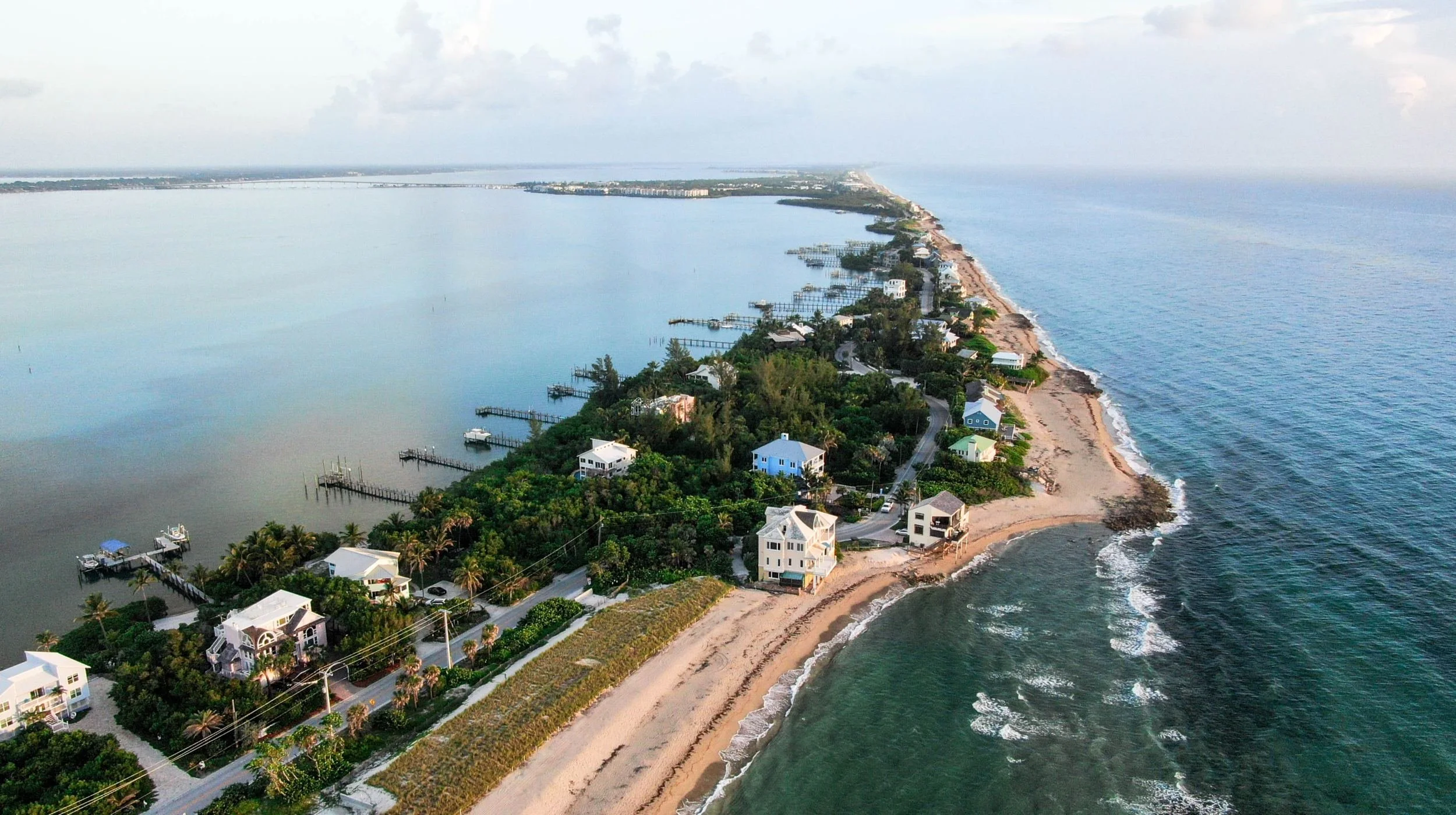
Homeowners Insurance in Jensen Beach, FL
We're an independent agency down in Stuart, about ten minutes from the Jensen Beach Causeway. We compare more than 40 Florida carriers and tell you straight what is driving your number, whether you're up on Skyline Drive, out on Indian River Drive, or across the water on Hutchinson Island.
Photo: Martin County Office of Tourism & Marketing
Jensen Beach is a harder town to quote than people expect, because it is really three or four different insurance markets sharing one ZIP code. A 1968 block home two streets off Indian River Drive gets underwritten nothing like a 2019 build in Pinecrest Lakes, and neither of those looks like an oceanfront condo at Island Dunes or a park model at Nettles Island. Same mail carrier, completely different conversations with a carrier.
That is the part that frustrates people who shop online. You put in a 34957 address and get a number that was priced off an average, then the real quote comes back and it is nothing like it. A Florida homeowners policy covers the same things here as anywhere else in the state. What changes is the price and the carrier list. What follows is what actually moves the price here, and where the coverage gaps tend to show up.
Mainland or Hutchinson Island: What Changes
The Indian River Lagoon splits Jensen Beach into two very different risks, and the causeway is the line.
On the mainland you are dealing with wind, tree exposure, and in places some real elevation, since the ridge along Skyline Drive and Mount Elizabeth is some of the highest ground on the Treasure Coast. Carriers are generally comfortable here, and if the roof is in decent shape you will usually have choices.
Across the causeway on Hutchinson Island, the math changes. You are on a barrier island with open Atlantic exposure, which means the wind rating goes up, more carriers decline outright, and the ones that stay want to see opening protection documented. Flood moves from a good idea to something close to non-negotiable, and on the oceanfront you may be in a V zone, where the rating rules are different and an elevation certificate is not optional.
Neither side is unwritable. They just need different carriers, and that is the whole argument for working with an agency that has more than one appetite to shop.
Your Mail Says Jensen Beach. Your County Might Not.
Here is something that trips up a surprising number of Jensen Beach homeowners. The 34957 mailing address reaches north past the Martin County line. If you are up on Hutchinson Island at Nettles Island, your mail says Jensen Beach but your property is in St. Lucie County.
That matters more than it sounds like it should. Your county determines which flood map applies to your parcel, which building department pulled your permits and holds your elevation certificate, and which Community Rating System discount you get on an NFIP policy. Martin County currently holds a Class 5 rating, which is a 25 percent reduction inside a special flood hazard area and 10 percent outside one. St. Lucie County's rating is set separately and is not the same number.
So when a carrier or a flood quote asks for your county, it is not a formality, and getting it wrong is one of the more common reasons a quote changes between the estimate and the bind. If you are not certain which side of the line you are on, tell us the address and we will pull it.
Every Jensen Beach Home Is in a Flood Zone
All of Florida is in a flood zone. The only real question is whether yours is a high one or a low one.
In Jensen Beach the spread is wide. The oceanfront strip on Hutchinson Island includes V zones, where wave action is part of the rating. Move back off the dune and you are generally into AE. The lagoon side, Indian River Drive, and the low ground near the Savannas run heavily AE. Get up onto the ridge and much of Pinecrest Lakes, Sugar Hill and the Skyline Drive area sits in X, which is the preferred zone.
Being in X does not mean dry. It means your mortgage company is not going to make you buy a policy, and that a preferred risk flood policy is usually cheap enough that skipping it is a bad trade. Most of the flood claims we see on the Treasure Coast are rainfall and drainage events, and those do not read the map first.
Your homeowners policy does not cover rising water. That is a separate flood policy, either through the NFIP or a private carrier, and we write both.
Flood Zones From the Ocean to the Savannas
Jensen Beach, ocean to ridge
VE is the oceanfront and dune on Hutchinson Island, where wave action is part of the rating and an elevation certificate is not optional.
AE covers most of the island behind the dune and the low mainland ground along Indian River Drive and toward the Savannas.
X is the higher ground rising to Pinecrest Lakes, Sugar Hill and the Skyline Drive ridge. Your lender will not require flood coverage in X, and a preferred risk policy there is cheap enough that going without is usually a bad trade.
Illustration, not to scale, and not a substitute for your parcel's actual zone. Zones vary street by street. Look yours up on the Martin County flood zone map, or send us the address and we will pull it.
What Changes by Property Type in Jensen Beach
| Property type | Typical areas | Wind exposure | Flood picture | What to watch for |
|---|---|---|---|---|
| Oceanfront condo | Island Dunes, Regency Island Dunes, Green Turtle Cove, Sandpebble | Highest | VE or AE | The gap between your association's master policy and your unit, and your loss assessment limit |
| Barrier island single family | Off NE Ocean Blvd and S Ocean Dr | Highest | VE or AE | Opening protection documented on the wind mit form, and finding carriers that will quote it at all |
| Manufactured or park model | Nettles Island, Ocean Breeze | High | AE or VE | Tie-downs and anchoring, year built, and what the park policy actually covers |
| Lagoon and river frontage | Indian River Drive, Sewalls Landing, Harborage | High | Mostly AE | Docks, lifts and seawalls are rarely covered by the home policy |
| Older mainland home, 1950s to 1970s | Skyline Drive, Leilani Heights, Jensen Park Estates | Moderate | Mixed AE and X | Roof age, original electrical, cast iron or polybutylene plumbing |
| 1990s to 2000s subdivision | Pinecrest Lakes, Holly Creek, The Pines, Windemere | Moderate | Mostly X | A roof approaching 20 years, and the screen enclosure sublimit |
| Newer build, 2010 and later | The Falls of Jensen Beach, scattered infill | Moderate | Mostly X | Usually the easiest to place. Make sure Coverage A tracks rebuild cost, not purchase price |
| Golf community home | Jensen Beach Country Club | Moderate | Mostly X | What the HOA covers versus what you do, plus cart and liability exposure |
Mainland or island, the carrier list is different.
Send us the address and we will shop it across the carriers that will actually write it. We will confirm which county your parcel sits in while we are at it.
How Hurricane Deductibles Work
| Hurricane deductible | You pay first | Premium effect | Who it fits |
|---|---|---|---|
| 2% | $12,000 | Highest premium | You want the smallest possible surprise after a storm and you are willing to pay for it every year |
| 5% | $30,000 | Middle | The common choice, and the right one if you can actually cover $30,000 on short notice |
| 10% | $60,000 | Lowest premium | Only if that number is genuinely liquid and sitting there waiting |
Example figures only, not a quote. The percentage applies to your Coverage A dwelling limit, which is what it costs to rebuild, not what the house would sell for. Your all other perils deductible is separate and is usually a flat amount like $1,000 or $2,500.
The hurricane deductible is a percentage of your dwelling limit, not a flat dollar amount, and it only applies once a named storm is declared. Everything else runs off your all other perils deductible, which is usually a flat number like $1,000 or $2,500.
The question we ask people is simple. If a named storm came through next month, could you write that check the same week? Not eventually, not after the claim settles. That week, to get a tarp on the roof and a crew started. If the answer is no, the premium savings on a 10 percent deductible is not savings. It is a deferred problem.
What Your Home Policy Covers, and What It Does Not
| Exposure | Standard HO-3 policy | What to do about it |
|---|---|---|
| Hurricane wind damage to the house | Coveredsubject to your hurricane deductible | Get the wind mitigation features documented. It is the cheapest way to bring the premium down. |
| Rising water and storm surge | Never covered | A separate flood policy, either NFIP or private. We write both. |
| Screen enclosure or pool cage | Limitedlow sublimit, sometimes excluded | Ask for the actual sublimit in writing before a storm, not after. Most people find out the wrong way. |
| Dock, boat lift, seawall | Rarely covered | Schedule them, or write them separately. Seawalls are usually excluded outright. |
| Loss assessment from your condo association | Limitedsmall default limit | Raise it. On the island this is the gap that bites hardest. See condo coverage. |
| Rebuilding to current building code | Limitedwithout Ordinance or Law | Matters most on homes built before the 2002 code. Ask what your Ordinance or Law limit actually is. |
| The boat itself | Barely covered | A separate boat policy. The small watercraft limit on a home policy will not go far here. |
Coverage varies by carrier and policy form. This is the general picture, not a description of your policy. Send us your declarations page and we will tell you exactly what yours does.
What Actually Moves Your Premium in Jensen Beach
Most to least impact, in our experience
-
1
Large impact
Roof age and covering
The first question every carrier asks. Shingle roofs tighten up around 15 to 20 years depending on the company, and past that you are often looking at actual cash value on the roof instead of replacement cost. Tile and metal run longer.
-
2
Large impact
Mainland or barrier island
Open Atlantic exposure on Hutchinson Island pushes the wind rating up and takes some carriers off the table entirely. Two identical houses, one on each side of the causeway, do not price the same.
-
3
Large impact
Which hurricane deductible you pick
The one lever you control outright. Moving between 2, 5 and 10 percent changes the premium more than most people expect, and changes what you owe after a storm by tens of thousands.
-
4
Large impact
Opening protection and the rest of the wind mit report
Impact rated windows and doors, or shutters on every opening. Partial protection scores as none. Roof to wall connections matter nearly as much, and neither counts unless it is documented on the form.
-
5
Moderate impact
Your Coverage A dwelling limit
What it costs to rebuild, not what the house would sell for. Set too low you are underinsured, set too high you are paying for coverage you cannot collect. Worth revisiting every few years as construction costs move.
-
6
Moderate impact
Year built and construction type
Concrete block prices better than frame, and the 2002 building code is a real dividing line. On older Jensen Beach homes this also brings electrical and plumbing into the conversation.
-
7
Moderate impact
Claims in the last five years
Water claims carry more weight than most people realize, often more than a wind claim of the same size. A single small claim can cost you more in premium over five years than it paid out.
-
8
Smaller impact
Credits and distance to fire protection
Monitored alarms, automatic water shutoff devices, and how far you are from a hydrant and a staffed station. Individually small, and they add up enough to be worth mentioning.
Notice what is not on this list: your credit-based insurance score matters in Florida, but roof and location outrank it here by a wide margin. If you want to know where your own house lands, send us the address and a declarations page.
What a Wind Mitigation Inspection Scores
Form OIR-B1-1802
- Building code year. When the house was permitted. A fixed feature you cannot change, and it carries real weight on either side of the 2002 code.
- Roof covering. The material and whether it meets current wind standards. Tied to roof age, which is the single biggest lever on a Jensen Beach premium.
- Roof deck attachment. How the sheathing is fastened to the trusses. Nail size and spacing, and the difference between them is worth money.
- Roof to wall connection. Toe nails, clips, single wraps or double wraps. Going from toe nails to wraps is one of the largest credits on the form.
- Roof geometry. Hip, gable or other. A fixed feature, and hip roofs earn a credit gable roofs do not.
- Secondary water resistance. A sealed layer under the covering. Most often added when the roof is replaced, so worth asking your roofer about before the work starts.
- Opening protection. Impact rated windows and doors, or shutters, on every opening. Partial protection scores as none, which surprises people.
New on the 2026 version of the form
The revised OIR-B1-1802 adds a design wind speed region field and a roof slope field, and it now requires a photograph or supporting document backing up every rated attribute. If your report predates the change it is still valid until it expires, but a new one will be more thoroughly documented.
A wind mitigation inspection is valid for five years under Florida law. If you have a current report, send it over with your quote request and we will tell you whether you are leaving credits on the table. More on how this differs from a four point or roof inspection in our guide to Florida home insurance inspections.
Get a Quote on Your Jensen Beach Home
Send us your current declarations page and we'll tell you honestly whether you're already in a good spot. If you are, we'll say so. If there's a better fit out there, we'll show you the comparison side by side. Call (772) 530-5305, or fill out the quote form and we'll get back to you the same business day.
Frequently Asked Questions
-
There is no single Jensen Beach number, and anyone quoting you one has not looked at your house yet. The four things that move it most here are the age and condition of your roof, whether you are on the mainland or on Hutchinson Island, your hurricane deductible, and how much opening protection you have documented. Two homes on the same street with the same square footage can be well over a thousand dollars apart on roof age alone. Send us the address and the current declarations page and we will give you real numbers from the carriers that will actually write it.
-
All of it is. All of Florida is in a flood zone, and the only question is whether yours is a high one or a low one. In Jensen Beach the oceanfront on Hutchinson Island includes V zones, much of the lagoon side and the low ground toward the Savannas is AE, and the higher ground around Pinecrest Lakes and Skyline Drive is largely X. X is the preferred zone, which means no lender requirement and a low enough premium that going without is usually a bad trade.
You can check your specific address on Martin County's FEMA flood zone map, and we are happy to look it up with you.
-
The county your parcel sits in, not the one on your mail. The 34957 ZIP reaches north of the Martin County line, so some Jensen Beach addresses on Hutchinson Island, Nettles Island among them, are in St. Lucie County. Your county determines which flood map governs your parcel, which building department holds your permits and elevation certificate, and which Community Rating System discount applies to an NFIP policy. If you are not sure, give us the address and we will confirm it before we quote.
-
Yes. Martin County participates in FEMA's Community Rating System and currently holds a Class 5 rating, which means a 25 percent premium reduction on NFIP policies inside a special flood hazard area and 10 percent outside one. You do not apply for it, it is applied automatically to eligible NFIP policies based on the community. St. Lucie County has its own rating, which is why the county question above matters.
-
You are not required to, and we would still recommend it. Lender requirements track the FEMA map, and the map is about where water is expected to go, not where it actually goes during a heavy rain event with a clogged drainage system. A preferred risk policy in an X zone is one of the cheapest pieces of coverage you can buy in this state, and your homeowners policy will not pay a dollar of a rising water claim.
-
Yes, and it is a narrower list of carriers than the mainland. Barrier island wind exposure takes some companies off the table entirely, and the ones that stay want opening protection documented on the wind mitigation form. For condo owners the bigger issue is usually not the building, it is the gap between your association's master policy and your HO-6, particularly the loss assessment limit. We read the master policy before we set your limits so those two documents line up.
-
Yes. These are written on different forms than a site built home and through a different set of carriers, and the underwriting turns on year built, tie-down and anchoring documentation, and roof condition. The thing worth checking early is what the park or association policy actually covers, because owners often assume more is included than is. We will read it with you.
-
Often yes, with fewer options and usually with the roof settled on actual cash value rather than replacement cost. Shingle roofs get tight around 15 to 20 years depending on the carrier, tile and metal run longer. What helps most is a recent roof inspection showing remaining useful life, and a wind mitigation report showing how the deck and the roof to wall connections were built. If replacement is coming anyway, it is worth knowing that a new roof usually pays back part of its cost in premium.
-
Usually not. Citizens is the state backed market of last resort, and Florida's private market has taken on considerably more business over the past few years, which means more homes that were stuck there now have private options. We check the private carriers first and go to Citizens when it is genuinely the right answer, which on the barrier island and on some older roofs it still is.
-
Four things, in roughly this order. Roof age and covering. Electrical, specifically whether there is any aluminum branch wiring or a panel brand carriers will not write. Plumbing, since cast iron and polybutylene both come up in homes of that era. And water heater age. Most of these older Jensen Beach homes are perfectly insurable, but a four point inspection will surface all of it, and it is better to know before you close than after.
-
Almost never, or only at a limit small enough not to matter. On the lagoon and along the St. Lucie River this is one of the most common surprises after a storm. Docks and lifts generally need to be scheduled or written separately, and seawalls are usually excluded outright. If you have water frontage, tell us what is on it and we will price the options rather than let you assume.
-
The policy forms are the same. The pricing is not. Jensen Beach has more barrier island exposure than Stuart does and considerably more than Port St. Lucie, which pushes wind rating up on the ocean side. It also has an older housing stock along the lagoon than most of Port St. Lucie, which brings roof and plumbing questions into play earlier. And the county line running through the ZIP code makes flood a more complicated conversation here than in any of the other three.
Palm City is the bigger contrast. It sits eight miles inland with no barrier island exposure at all, so wind rates better there, but its flood risk follows the river and creeks instead of the coast.
Six Terms Worth Knowing Before You Compare Quotes
- Coverage A
- Your dwelling limit. It is what it would cost to rebuild the house, not what it would sell for and not what you paid. Your hurricane deductible is a percentage of this number, which is why it matters more than people think.
- All other perils deductible
- The deductible that applies to everything that is not a named storm. Usually a flat amount like $1,000 or $2,500, and separate from your hurricane deductible.
- Loss assessment
- Coverage for your share when a condo association bills owners for damage the master policy did not fully cover. The default limit is often small. On Hutchinson Island this is the gap we see bite hardest.
- Ordinance or Law
- Pays the extra cost of rebuilding to current code rather than to how the house was originally built. On a home built before the 2002 code that difference can be substantial.
- Replacement cost vs actual cash value
- Replacement cost pays what it takes to replace the item today. Actual cash value subtracts depreciation first. Older roofs are the place this shows up most, and it is the difference between a new roof and a partial check.
- Elevation certificate
- A surveyed document showing how high your lowest floor sits relative to the base flood elevation. It drives flood pricing in AE and VE zones, and Martin County may already have one on file for your parcel.