

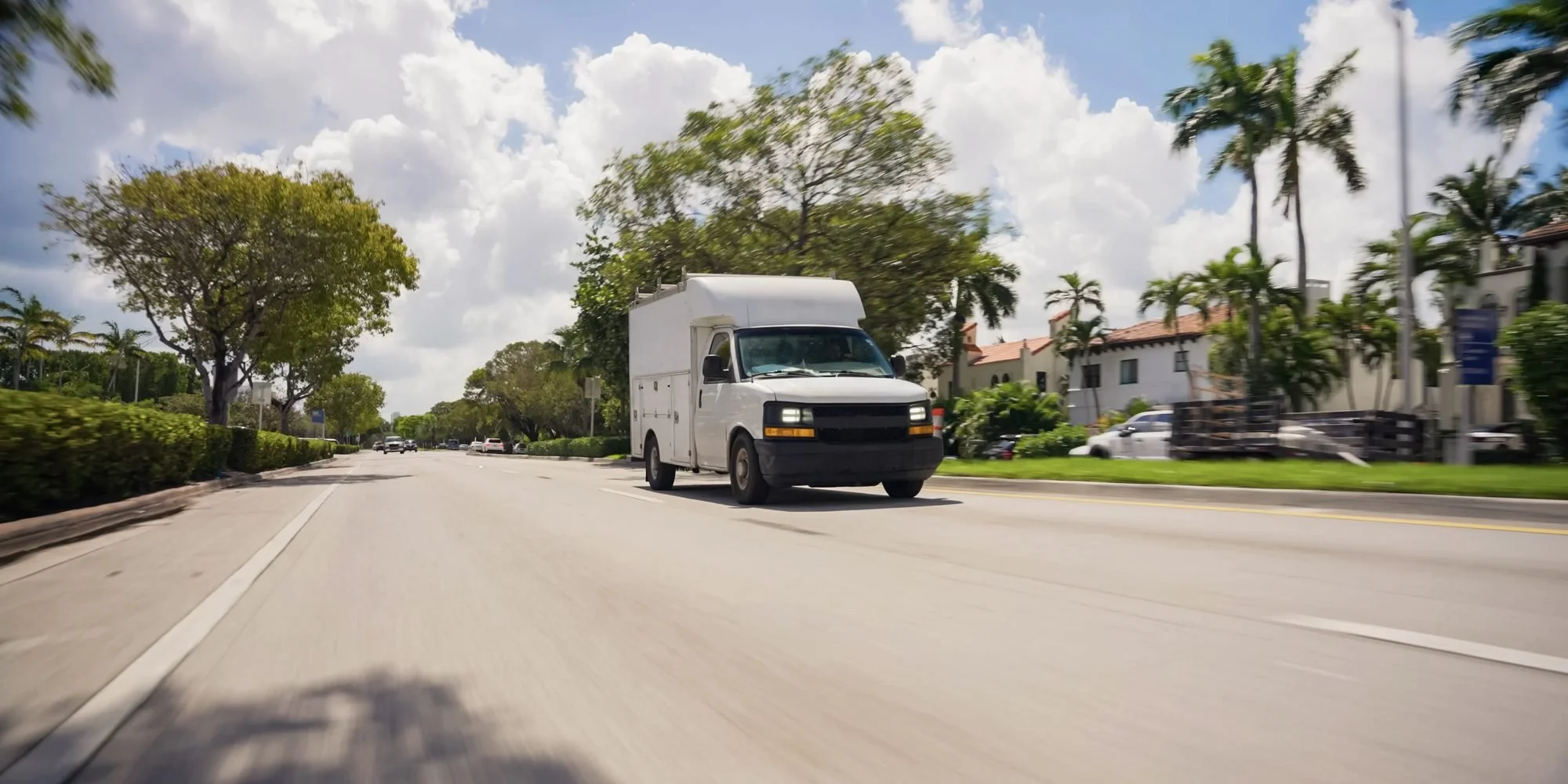
Business vehicle coverage · Stuart, FL
Commercial Auto Insurance in Florida for Work Trucks, Vans and Fleets
We help Treasure Coast businesses insure the trucks, vans and cars they use for work. Our office is in Stuart, and we look at the commercial auto options that fit your type of business, your vehicles and your drivers.

- Independent agency since 2017
- 40+ carrier appointments
- Local office in Stuart
What is commercial auto insurance?
Commercial auto insurance is a policy built for vehicles that are used for work. It is usually written in the name of the business, not a person. It can cover the trucks, vans and cars your company owns or leases, the people who drive them, and the harm those vehicles can cause to other people.
A business vehicle is a different risk than a family car. It may carry tools or materials. It may be driven by employees. It may be on the road all day, going from job to job. Because of that, commercial auto policies are underwritten and classified differently than personal auto insurance, and they are often written with higher liability limits.
If you own, lease, rent or simply use vehicles for your business, it is worth knowing where your current coverage starts and stops. Eligibility, coverage choices and price depend on what your business does, the vehicles, the drivers, how and where the vehicles are used, and the insurance company's own rules. For most companies, commercial auto is one piece of a broader business insurance program.
What does commercial auto insurance cover?
Most commercial auto policies are made of two kinds of coverage. Liability coverage pays for harm you cause to other people. Physical damage coverage pays to fix or replace your own vehicle. You can have one without the other, so it helps to know which is which.
Protects others from you
Pays for injuries and property damage your business vehicle causes to other people, up to your limits. It can also pay for a legal defense when someone files a claim against the business. Liability does not fix your own truck.
Protects your vehicle
Collision and comprehensive pay to repair or replace the vehicles listed on your policy, minus your deductible. If a vehicle is paid off, physical damage may be optional. If it is financed or leased, the lender or leasing company usually requires it.
Bodily injury liability
Helps pay for injuries to other people when your business vehicle is at fault, such as medical bills, lost wages and legal costs, up to the limit.
Property damage liability
Helps pay for damage your vehicle causes to someone else's property, like another car, a fence, a mailbox or a building.
Combined single limit (CSL)
Many commercial policies use one total limit per accident for bodily injury and property damage together, instead of separate limits. A $1,000,000 CSL, for example, is one pool of money for the whole accident.
Collision
Pays to repair your vehicle after it hits another vehicle or an object, or rolls over, no matter who is at fault.
Comprehensive
Pays for damage that is not a crash, such as theft, vandalism, fire, falling objects, hail, wind and flood. It covers flood damage to the vehicle only. Your building and its contents need separate flood insurance.
Uninsured and underinsured motorist
Helps pay for injuries to your drivers and passengers when the other driver has no insurance or not enough. In Florida it can usually be rejected or lowered only in writing, so it is worth a real conversation.
Personal injury protection (PIP)
Florida is a no-fault state. PIP helps pay certain medical costs and lost income after a crash, regardless of fault. Florida requires it to register most vehicles with four or more wheels. Who PIP covers on a business policy depends on the policy and Florida law.
Medical payments
Helps pay medical bills for people in your vehicle after an accident. In Florida it is often used alongside PIP, not instead of it.
Hired and non-owned auto
Liability protection for vehicles your business rents or borrows, and for employees' own cars used on company business. See how hired and non-owned auto works.
Trailers
Trailers you own can often be listed on the policy. Liability while towing usually comes from the vehicle pulling it, but damage to the trailer itself generally needs to be covered separately.
Other options
Towing and labor, rental reimbursement, loan or lease gap, and additional insured or waiver endorsements that contracts may require. Not every insurer offers every option.
Which coverage pays? Real-world examples
Pick a situation to see which part of a commercial auto policy usually responds, and where the gaps tend to be.
An employee rear-ends another car in your work van
Bodily injury and property damage liability help pay for the other driver's injuries and car, up to your limits. Collision helps repair your van, minus your deductible, if you carry it. In Florida, PIP plays a part in medical costs after a crash.
Watch for: injuries to your own employee on the job are often handled through workers' compensation. The driver also needs to be an approved driver on your policy.
Hail, wind or flood water damages your work truck
Comprehensive is the coverage for damage that is not a crash, including storms, falling trees and flood water. It pays to repair or replace the truck, minus your deductible, if it is on the policy.
Watch for: a liability-only policy will not pay to fix your own truck. Your building and its contents need separate flood insurance and property coverage.
Tools and equipment are stolen out of your truck overnight
Commercial auto is written for the vehicle, not what is inside it. Stolen tools and equipment are usually covered by an inland marine or contractor's equipment policy, if you have one. A broken window or damaged lock on the truck itself may fall under comprehensive.
Watch for: many contractors assume the auto policy covers their tools. Ask about tools coverage when you request your quote.
A box truck you rented for a job is damaged
Hired auto liability helps if the rental truck injures someone or damages their property. Damage to the rental truck itself usually needs hired auto physical damage, which some insurers offer as an add-on, or coverage bought from the rental company.
Watch for: check what your policy includes before you rent, not at the counter. How hired and non-owned auto works.
An employee crashes their own car while running a work errand
The employee's own personal auto policy is usually expected to respond first. If the injured party also goes after your business, non-owned auto coverage can protect the company from liability.
Watch for: non-owned auto generally does not pay to repair the employee's car. Businesses with no company vehicles often still need it.
An uninsured driver hits your company van
Uninsured motorist coverage helps pay for injuries to your driver and passengers when the at-fault driver has no insurance or not enough. Collision helps repair your van, minus your deductible.
Watch for: in Florida, uninsured motorist coverage can usually be rejected or lowered only in writing. If it was turned down, this protection may not be there.
These examples are general. What is actually covered depends on your policy, its limits and endorsements, and the facts of the claim.
How it fits with your other business policies. A general liability policy usually excludes accidents involving vehicles your business owns, which is why commercial auto is written separately. Injuries to your own employees on the job are often handled through workers' compensation rather than the auto policy. Our business insurance page explains general liability, workers' compensation and commercial property coverage for Florida businesses.
This is general information, not policy language. A commercial auto policy does not automatically include every coverage listed here. What is covered, what is excluded and what limits apply are set by the actual policy, its declarations page and its endorsements.
Who needs commercial auto insurance?
Any business that owns, leases or regularly uses vehicles for work should look at it. Around the Treasure Coast, that includes many of the trades and service companies that keep the area running. Here are the types of businesses we hear from most, grouped by how they use their vehicles.
Trades and construction
Pickups, vans and trucks carrying crews, tools and materials to job sites.
- General contractors
- Construction companies
- Electricians
- Plumbers
- HVAC companies
- Roofers
Building or remodeling? Projects under construction are covered by builder's risk insurance, not your auto policy.
Property and outdoor services
Route-based vehicles making several stops a day, often towing trailers or hauling equipment and supplies.
- Landscapers and lawn care
- Pool service companies
- Cleaning companies
- Pest control businesses
Delivery and transportation
Vehicles that move goods or people. Some of these operations need specialized coverage or regulatory filings.
- Delivery businesses
- Transportation businesses
- Businesses hauling goods for customers
Real estate, property and sales
Often employees driving their own cars to showings, properties and client meetings.
- Real estate offices
- Property management companies
- Sales representatives
Any business with vehicles
Your industry matters less than the fact that vehicles are part of how you work.
- Businesses with company-owned vehicles
- Businesses running several vehicles
- Businesses that rent vehicles for jobs
Being in one of these fields does not mean every business needs the same policy. A solo pool tech in a pickup, a roofing crew with three trucks and trailers, and a property manager whose staff drive their own cars all have different needs. The right setup depends on four things:
- Ownership
- Is the vehicle owned or leased by the business, the owner personally, or an employee?
- Drivers
- Who drives it, and do employees take it home at night?
- Cargo
- Does it carry people, tools, materials or goods for customers?
- Radius
- How far and how often does it go, and does it ever leave Florida?
Commercial auto vs. personal auto insurance
A personal auto policy is written for an individual or a household. A commercial auto policy is written for a business. Some business driving can be covered on a personal policy, and some cannot. It depends on the policy wording, how the vehicle is used, and who owns it. Here is how the two usually differ.
| Topic | Personal auto | Commercial auto |
|---|---|---|
| Intended use | Commuting, errands and family driving. Some limited work use may be allowed, depending on the policy. | Vehicles used to run the business: job sites, service calls, deliveries, hauling. |
| Named insured | One or more individuals in a household. | Usually the business entity, such as an LLC or corporation. |
| Vehicle ownership | Vehicles titled to the individual or household. | Vehicles owned or leased by the business, plus hired and non-owned options. |
| Drivers | Household members and occasional permitted drivers. | Employees and other approved drivers, often reviewed by the insurer. |
| Liability exposure | Ordinary personal driving. | More time on the road, heavier vehicles, cargo and contract demands. Higher limits are common. |
| Vehicle types | Cars, SUVs, minivans and light pickups. | Cars through heavy trucks, rated by weight, body type, use and radius. |
| Underwriting | Driver history, vehicle and garaging address. | Type of business, years in business, every driver's record, vehicle use, radius and loss history. |
| Coverage options | Standard personal coverages and add-ons. | Business options such as hired and non-owned auto, CSL limits and contract endorsements. |
| Several vehicles | Usually limited to a household's cars. | Built to handle several vehicles and growing fleets on one policy. |
Why it matters: if a business vehicle is insured on a personal policy and the insurer decides the use was outside what the policy covers, a claim could be limited or denied. The fix is simple. Tell the agency exactly how the vehicle is used, and let the insurance company classify it correctly from the start.
If you only need coverage for your household cars, our personal auto insurance page and Florida auto insurance FAQs are the better place to start. Collector vehicles are a separate product too, covered on our classic car insurance page.
Hired and non-owned auto insurance
You do not need a fleet to have a vehicle risk. If your employees drive their own cars to see clients, or you rent a truck for a big job, your business can still be pulled into a claim. Hired and non-owned auto coverage, often called HNOA, is meant for that gap.
Hired auto
Vehicles your business rents, leases for a short time, or borrows for business use, based on how the policy defines them. Think of a rental box truck for a move or a rental car on a sales trip.
Non-owned auto
Vehicles your business uses but does not own, such as an employee's personal car used to run errands, visit job sites or meet customers for the company.
What HNOA does and does not do
- It generally protects the business from liability when one of these vehicles hurts someone or damages their property.
- It usually does not pay to repair a rented car or an employee's car. Physical damage for hired vehicles may be available as a separate endorsement with some insurers.
- The employee's own personal auto policy is usually expected to respond first when they drive their own car.
- HNOA can be added to a commercial auto policy, and some insurers offer it with other business insurance policies. The exact coverage depends on the policy wording and endorsements.
Office-based businesses, real estate teams, property managers and consultants often use HNOA even when the company owns no vehicles at all.
Commercial auto insurance in Florida
Florida rules for business vehicles come from a few places. It helps to sort them into four buckets, because a requirement from a customer is not the same thing as a requirement from the state.
1. What Florida requires for most vehicles
To register a vehicle with four or more wheels in Florida, the owner must show proof of personal injury protection (PIP) and property damage liability (PDL). That coverage must stay in force as long as the registration is active, even if the vehicle is parked. This applies to many business vehicles, not just family cars. The Florida Department of Highway Safety and Motor Vehicles lists the current minimums, and our Florida auto insurance FAQs explain PIP in plain English. Florida does not set a general bodily injury liability minimum for most vehicles, but that is a legal floor, not a recommendation for a business.
2. Rules for certain vehicles and operations
Some vehicles and businesses have extra rules on top of the basics:
- Heavier commercial trucks. Florida sets higher liability minimums for commercial motor vehicles based on weight.
- Vehicles for hire. Taxis and some passenger services have their own liability requirements.
- Interstate carriers. Businesses that run commercial vehicles of 10,001 pounds or more across state lines generally need a USDOT number from the Federal Motor Carrier Safety Administration. Florida also requires USDOT numbers for some carriers that only operate inside the state.
- For-hire and hazmat carriers. Many must carry federal minimum limits and have their insurance company file proof with FMCSA. See FMCSA's insurance filing requirements.
Which rules apply depends on vehicle weight, what you haul, whether you are paid to haul it, and where you drive. If you are not sure, ask before you buy a policy, so it is set up for the right filings.
3. What lenders, customers and contracts require
This is where many Florida businesses get surprised. A lender or leasing company may require collision and comprehensive. A general contractor, property manager or government agency may require a certain liability limit before you can start work. Contracts may also ask for certificates of insurance, additional insured status or a waiver of subrogation. Send us the insurance section of your contract and we can show it to the insurance company when we quote.
4. What you choose for your own protection
Higher liability limits, uninsured motorist coverage, physical damage on older vehicles, rental reimbursement and towing are usually your choice. The state minimum keeps a vehicle legal to register. It was not designed to protect a business from a serious accident claim. A personal umbrella policy is built for your personal home and auto exposures and usually is not designed for business vehicles, so ask about commercial umbrella or excess liability if you need limits above your auto policy.
Drivers and motor vehicle records
Insurance companies review each driver's motor vehicle record (MVR). Accidents, tickets, license suspensions and years of driving experience can affect eligibility and price, and some insurers will not accept certain drivers. Tell us about every person who drives for the business, including part-time help.
This section is a general overview, not legal advice. Laws and regulations change. Check current requirements with the agencies linked above, and talk with your attorney about contract or regulatory questions.
Commercial auto for contractors and small businesses
Most of the commercial vehicles on Treasure Coast roads are not semi trucks. They are pickups, vans and box trucks owned by local contractors and service companies. Here are some common setups and what to think about with each.
Pickup trucks
Often used for job sites and towing. Note any trailers, ladder racks or tool boxes, and whether the truck is also used personally.
Work vans
Service vans for plumbers, electricians, HVAC and cleaning crews. Tell us about upfits like shelving and racks so they can be valued correctly.
Trucks carrying tools and equipment
The truck may be covered, but the tools inside usually are not. See the note below.
Vehicles carrying employees
Crews riding to job sites raise injury exposure. Insurers want to know how many people ride and how often.
Customer visits
Estimators, sales reps and property managers drive all day. Radius and mileage matter here.
Hauling materials
Landscapers, pool companies and builders carrying mulch, chemicals, pavers or lumber should describe what they haul and how much.
Several vehicles
Two or more vehicles usually belong on one business policy, which keeps limits and renewal dates in one place.
Employees driving company vehicles
Who can drive, whether vehicles go home at night, and family use after hours all affect how the policy should be written.
Tools and equipment are a separate question. Commercial auto insurance is generally written to cover the vehicle and your liability for using it. It does not automatically cover tools, materials, equipment or customer property inside the vehicle. Those are usually handled with inland marine coverage, such as a contractor's equipment or tools policy, or other business insurance. Ask about it when you request your commercial auto quote. If you build or remodel, our builder's risk insurance page covers projects under construction.
The most important thing you can do is describe your vehicle use and your drivers honestly and completely. An accurate application helps the insurance company rate the policy correctly and helps avoid problems at claim time.
Commercial auto vs. commercial truck insurance
"Commercial auto" and "commercial truck insurance" are often used to mean the same thing, but in practice they cover very different risks.
Typical commercial auto
- Cars, SUVs, pickups and work vans
- Light and medium trucks used by your own business
- Local service and job site driving
- Delivering your own products to customers
- Trailers pulled by those vehicles
Often specialized trucking
- Heavy trucks, tractors and semi trailers
- Hauling goods for others for pay
- Regular trips across state lines
- Dump trucks, tow trucks and hazmat
- Operations that need federal or state filings
Trucking risks often need different insurance companies, different underwriting, motor carrier liability, cargo coverage and regulatory filings. One commercial auto policy is not the right answer for every truck or transportation business. If your business fits the right-hand column, tell us up front so we look in the right place.
What affects commercial auto insurance costs?
There is no honest average price for commercial auto insurance in Florida. Two businesses with the same truck can pay very different premiums. These are the main things insurance companies look at:
The vehicle
Type, value, weight and classification. A heavy dump truck rates differently than a compact van.
How many vehicles
More vehicles mean more exposure, but the insurer looks at the whole operation, not just the count.
What your business does
A roofer and an interior designer have very different driving risks.
Use, mileage and radius
How many miles you drive and how far from home base you usually go.
Drivers
Age, experience and each driver's motor vehicle record.
Claims history
Past accidents and claims for the business, often for the last three to five years.
Limits and deductibles
Higher liability limits cost more. Higher physical damage deductibles usually cost less.
Garaging location
Where vehicles are kept overnight. Traffic, theft and storm exposure all play a part.
The insurance company
Each insurer has its own rules, appetite and pricing for different types of businesses.
When you compare quotes, look past the price. Check the liability limit, which vehicles and drivers are listed, the deductibles, whether hired and non-owned auto is included, and any exclusions. A lower premium with a smaller limit or a missing driver is not the same policy.
Why work with an independent insurance agency?
A captive agent sells one company's policies. An independent agency like Manchester Insurance is appointed with several insurance companies. We hold 40+ carrier appointments across personal and business insurance, and we know which ones tend to write commercial auto for which kinds of businesses.
That does not mean every company will quote every business, or that we shop every request to every carrier. It means we can point your request toward the insurers most likely to want it, and save you from filling out the same forms over and over. Here is what we help with:
- Finding which insurance companies are a fit for your type of business and vehicles
- Explaining coverage differences between quotes
- Comparing liability limits, including what your contracts call for
- Walking through deductible choices
- Reviewing how vehicles and drivers are classified
- Explaining what each insurer needs for underwriting
- Helping you sort out commercial auto options in Florida as your business grows
Quotes from different companies are not always built the same way, so we point out the differences instead of just showing you the lowest number. You can also see the full list of insurance we offer for your business and household.
Four simple steps
How getting a commercial auto quote works
Here is what happens when you ask us for a commercial auto quote for your business vehicles.
Prefer to talk? Call 772-530-5305
-
Tell us about your business
Share what your business does, how many vehicles you run, how they are used and where they are parked at night.
If a customer or contract requires certain limits, send us that insurance section too.
-
Share your vehicle and driver details
Insurance companies need VINs, driver's license information and your recent claims history to underwrite the policy.
See what to have ready so nothing slows you down.
-
We check the companies that fit
We look at the insurance companies that write your type of business, vehicles and drivers.
Not every company will quote every business.
-
We walk you through it
We explain the coverage, liability limits, deductibles and price of the options we find. You decide, and coverage starts once the insurance company approves and binds the policy.
There is no cost to get a quote and no obligation.
What to have ready for a commercial auto quote
Having this ready makes the process faster. If you do not have all of it, start anyway. We will tell you what is still needed.
Commercial auto quote checklist | Manchester Insurance | (772) 530-5305
0 of 16 items ready
About the business
About the vehicles
About the drivers
Common mistakes to avoid
- Keeping a work truck on a personal policy without telling the insurer how it is used
- Leaving a driver off the policy, including part-time help
- Assuming tools in the truck are covered
- Forgetting employees who drive their own cars for work
- Buying the lowest limit when a contract calls for more
- Not updating the policy when you add a vehicle or driver
Your checkmarks are saved only in this browser on this device.
Already insured with us? To add or remove a vehicle or driver, or to ask about a certificate of insurance, visit our customer service center. You can also make a payment online.
Serving businesses across the Treasure Coast
Manchester Insurance is a family-owned independent agency based in Stuart, Florida, founded in 2017. Our office is on SE Indian Street, and we work with business owners throughout Stuart, Palm City, Jensen Beach and Hobe Sound in Martin County, and Port St. Lucie in St. Lucie County.
We also help businesses north in Vero Beach and south through Tequesta, Jupiter, Palm Beach Gardens and West Palm Beach in Palm Beach County. Your vehicles probably cross county lines every day, and we also work with businesses based elsewhere in Florida.
Learn more about Manchester Insurance or meet the team in our Stuart office.
Talk with our Stuart office
Manchester Insurance, LLC
1239 SE Indian St., Suite 101
Stuart, FL 34997
Phone: (772) 530-5305
Email: hello@manchesterins.com
Hours: Monday to Friday, 9am to 5pm
Commercial auto insurance FAQs
What is commercial auto insurance?
It is auto insurance written for a business and the vehicles it uses for work. It can include liability for injuries and damage you cause to others, physical damage for your own vehicles, and other coverages such as uninsured motorist and hired and non-owned auto. What it includes depends on the policy you buy.
Is commercial auto insurance required in Florida?
Florida requires PIP and property damage liability to register most vehicles with four or more wheels, including many business vehicles. Heavier commercial trucks, vehicles for hire and interstate carriers can have higher requirements. Florida does not have one rule that says every business must buy a "commercial" policy, but a personal policy may not fit a vehicle used for business. Lenders, customers and contracts often require more.
How much does commercial auto insurance cost in Florida?
It depends on the vehicles, drivers, type of business, how far you drive, your claims history, the limits and deductibles you choose, and the insurance company. Because those factors vary so much, we do not publish average prices. A quote based on your actual business is the only reliable number.
What businesses need commercial auto insurance?
Businesses that own or lease vehicles, have employees who drive for work, carry tools or materials, transport people, or make deliveries should look at it. Contractors, trades, landscapers, pool and cleaning services, delivery businesses and property managers are common examples. The right policy depends on how your vehicles are owned and used.
What is the difference between commercial and personal auto insurance?
Personal auto is written for individuals and household driving. Commercial auto is written for a business, its vehicles and its drivers. Commercial policies use different vehicle classes and underwriting, often carry higher liability limits, and offer business options like hired and non-owned auto. Whether a personal policy covers a work trip depends on its wording and how the vehicle is used. For household cars, see our personal auto insurance page.
Does commercial auto insurance cover employees driving company vehicles?
Usually, if the employee is an approved driver and is using the vehicle with permission. Most insurers want every regular driver listed and will review their driving records. Some drivers may be excluded or not accepted. Check your policy's driver and permitted-use terms.
Does commercial auto insurance cover employee-owned vehicles?
Not automatically. When employees drive their own cars for work, their personal policy is usually expected to respond first. Non-owned auto coverage can protect the business from liability in those situations. It generally does not pay to repair the employee's car.
What is hired and non-owned auto insurance?
Hired auto applies to vehicles your business rents or borrows. Non-owned auto applies to vehicles your business uses but does not own, like an employee's car on company errands. Together they mainly protect the business from liability. Physical damage to those vehicles usually is not included unless the policy adds it.
Does commercial auto insurance cover rented vehicles?
Liability for rented vehicles may be covered if your policy includes hired auto coverage. Damage to the rental itself may need a separate hired auto physical damage endorsement, or coverage from the rental company. Ask before you rent so you know which applies.
Does commercial auto insurance cover tools inside a work truck?
Generally, no. Commercial auto is written for the vehicle and your liability for driving it. Tools, equipment and materials are usually covered by inland marine coverage, such as a tools and equipment policy, or by other business insurance. Permanently attached equipment may be treated differently, so tell us what is installed on the vehicle.
Does commercial auto insurance cover a trailer?
It can. Liability while towing usually comes from the vehicle pulling the trailer. Damage to the trailer itself generally requires the trailer to be listed with physical damage coverage. Some policies have rules based on trailer type and weight, so list every trailer you use.
Can I insure multiple business vehicles under one policy?
Yes, in most cases. A commercial auto policy can list several vehicles and drivers, which keeps limits and renewal dates together. Larger fleets may be written differently depending on the insurer.
Can a contractor get commercial auto insurance?
Yes. Contractors are among the most common commercial auto customers. Insurers will ask about the type of work, the vehicles, the drivers, trailers and how far you travel. Some trades and vehicle types are a better fit for certain insurers than others, and acceptance is always up to the insurance company. Contractors building or renovating should also look at builder's risk insurance for the project itself.
Does commercial auto insurance cover delivery vehicles?
It can, but the details matter. Delivering your own products to your customers is different from delivering goods for others for pay, or driving for an app-based delivery platform. Tell us exactly how deliveries work, since some delivery operations need specialized coverage.
What is commercial truck insurance?
It is coverage for trucking operations, such as heavy trucks, tractor trailers and businesses that haul goods for others. It often includes motor carrier liability and cargo coverage, and may require federal or state filings. It is usually written by insurers that specialize in trucking.
Does commercial auto insurance cover vehicles used outside Florida?
Many commercial auto policies cover trips to other states, but the policy territory, your stated operating radius and any required filings matter. Regular trips across state lines with heavier vehicles can also bring federal rules into play. Tell us where your vehicles go.
What information is needed to get a commercial auto quote?
Your business name and what it does, garaging addresses, each vehicle's year, make, model and VIN, each driver's name, date of birth and license number, how the vehicles are used, and your recent claims history. A current declarations page and any contract insurance requirements help too. When you are ready, start your commercial auto quote online.
Can an independent insurance agency compare commercial auto insurance options?
Yes. An independent agency works with several insurance companies, so it can request quotes from the ones that fit your business. Not every insurer will quote every business, and quotes may not be built on identical terms, so a good agent explains the differences instead of only the price.
Does commercial auto insurance cover personal use of a company vehicle?
It depends on the policy and who is driving. Many commercial policies allow some personal use by approved drivers, but family members, after-hours use and personal errands may be treated differently. If company vehicles go home at night, tell us so the policy can be set up for it.
Helpful resources
These official sources explain Florida and federal vehicle insurance rules in more detail.
- Florida Insurance RequirementsFlorida Highway Safety and Motor Vehicles: PIP and property damage liability rules for registration.
- Do I Need a USDOT Number?FMCSA: who must register commercial vehicles, including intrastate rules.
- Insurance Filing RequirementsFMCSA: federal minimums and filings for for-hire and hazmat carriers.
- Small Business InsuranceNAIC: plain-language questions to ask about business and commercial auto coverage.
Related insurance for your business
Ready to look at commercial auto options for your business?
Start a quote online and let us know it is for business vehicles, or call our Stuart office. Someone on our team will follow up, ask what we need for underwriting, and walk you through the options that are available for your business.
Manchester Insurance, LLC | 1239 SE Indian St., Suite 101, Stuart, FL 34997 | Monday to Friday, 9am to 5pm | Contact our office
This page is for general educational purposes only. It is not an offer of coverage, a binding quote or legal advice. Coverage, limits, eligibility and pricing vary by insurance company and are subject to underwriting approval. The terms of your actual policy control in the event of any difference.